
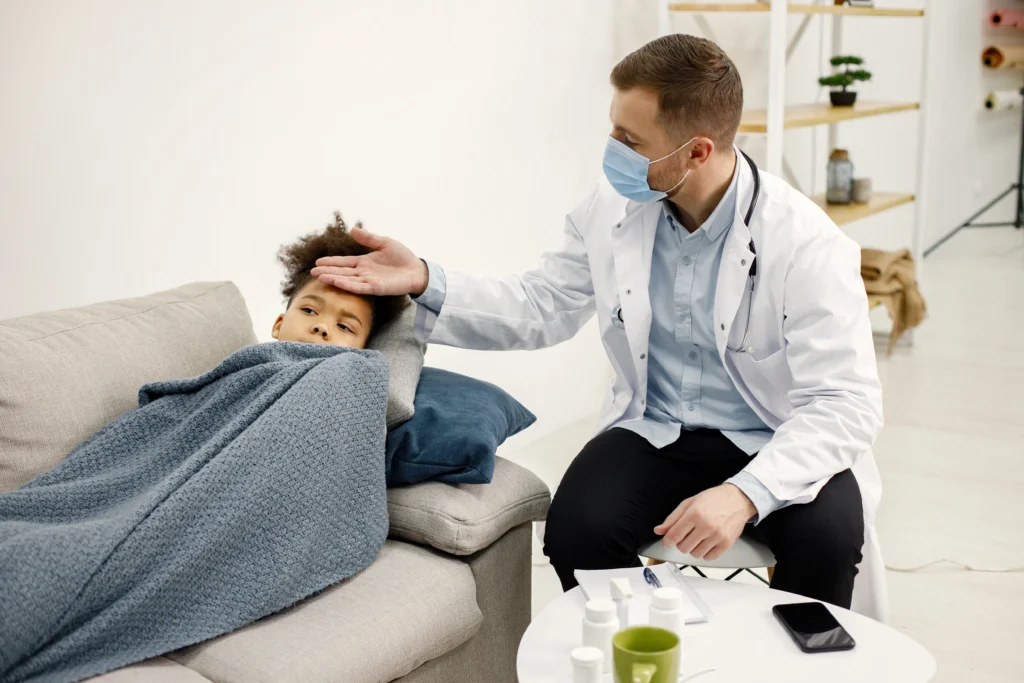
Few things are as frightening for a parent as watching their child have a seizure. When a seizure happens during a fever, it is called a febrile seizure. These seizures are surprisingly common, affecting about 2 to 5 out of every 100 young children, and most are harmless.
Still, every first seizure should be checked by a doctor, and some situations require emergency care right away. Our emergency room for pediatrics in Orange, TX, is open 24/7 with an ER wait time of 15 minutes or less.
What Is A Febrile Seizure?
A febrile seizure is a convulsion caused by a fever in a child between 6 months and 5 years old. It most often happens on the first day of an illness, sometimes before parents even realize their child has a fever. The seizure is caused by how a young child’s developing brain reacts to a fast rise in body temperature, not by how high the fever gets.
According to the National Institute of Neurological Disorders and Stroke, febrile seizures do not cause brain damage, and most children who have them do not develop epilepsy.
What Causes Febrile Seizures?
- Viral infections: such as the flu, roseola, ear infections, and colds.
- Bacterial infections: less commonly, such as urinary tract infections.
- Vaccines: in rare cases, a fever after certain vaccines can trigger a seizure.
- Family history: children with a parent or sibling who had febrile seizures are more likely to have them.
Signs Of A Febrile Seizure
During a febrile seizure, a child may:
- Lose consciousness.
- Shake or jerk their arms and legs.
- Become stiff or limp.
- Roll their eyes back.
- Breathe irregularly or have trouble breathing.
- Wet themselves or vomit.
Most febrile seizures last less than two minutes. Afterward, your child may be sleepy or confused for a short time.
Simple Vs. Complex Febrile Seizures
Simple Febrile Seizures
These are the most common type. They last less than 15 minutes, affect the whole body, and do not happen again within 24 hours.
Complex Febrile Seizures
These last longer than 15 minutes, affect only one side or part of the body, or happen more than once within 24 hours. Complex seizures need more careful evaluation to look for other causes.
What To Do During A Febrile Seizure
- Stay calm: and note the time the seizure started.
- Place your child on a safe surface: such as the floor, on their side.
- Remove nearby objects: that could cause injury.
- Do not put anything in their mouth: including fingers or medicine.
- Do not try to hold them down.
- Loosen tight clothing: around the neck.
- Stay with your child: until the seizure ends and they are fully awake.
When To Call 911
Call 911 right away if your child:
- Has a seizure lasting longer than 5 minutes.
- Has trouble breathing or turns blue.
- Does not wake up or respond normally after the seizure.
- Has more than one seizure.
- Has a stiff neck, severe headache, or a rash that does not fade when pressed.
- Is younger than 6 months old.
Why Your Child Should Be Seen After A First Seizure
Even if the seizure stops on its own and your child seems fine, take them to be checked after their first febrile seizure. Doctors want to find the source of the fever and rule out serious infections like meningitis.
At our pediatric emergency room, physicians may examine your child, test for infections such as flu or UTI, and, in some cases, order blood work or other tests.
Managing Fever At Home
Fever reducers such as acetaminophen or ibuprofen can make your child more comfortable, but research shows they do not prevent febrile seizures. Keep your child hydrated and dressed in light clothing. If a fever stays high or your child seems very ill, a fever emergency room visit can help find and treat the cause.
Will It Happen Again?
About one in three children who have a febrile seizure will have another one, usually within a year. The risk is higher if the first seizure happened before 18 months of age, the fever was low when the seizure occurred, or there is a family history of febrile seizures.
Frequently Asked Questions
Are Febrile Seizures Dangerous?
Most simple febrile seizures are harmless and do not cause brain damage or learning problems.
Do Febrile Seizures Lead To Epilepsy?
Most children never develop epilepsy. The risk is only slightly higher than in children who have not had febrile seizures.
Can I Prevent Febrile Seizures?
There is no reliable way to prevent them. Fever medicine may help comfort but does not stop seizures.
At What Age Do Febrile Seizures Stop?
Most children outgrow them by age 5 or 6.
Pediatric Emergency Care In Orange, TX
Febrile seizures are frightening, but most children recover fully. Having a trusted ER nearby can bring peace of mind. Exceptional Emergency Center cares for families in Orange, Vidor, and nearby Southeast Texas communities with board-certified physicians and on-site labs.
If you need the nearest emergency room for your child, we are open 24/7. For life-threatening emergencies, call 911 right away.